
Aruba vs. Grand Cayman: Which Caribbean Island Should You Visit?

Two of the Caribbean’s most popular upscale destinations, compared category by category, so you can make the call with confidence.
Choosing between Aruba and Grand Cayman is one of the more genuinely difficult decisions in Caribbean travel. These two islands share more DNA than almost any other pairing in the region: both are exceptionally safe, both have world-class beaches, both attract a well-traveled crowd, and both deliver a polished, high-quality vacation experience. Neither is a bad choice.
But they’re not identical, and depending on your priorities, one will suit you significantly better than the other.
This guide breaks down Aruba vs. Grand Cayman across every category that matters: beaches, weather, safety, cost, diving, food, nightlife, activities, and where to stay, so you can stop debating and start packing.
Disclosure: Some of the links below may be affiliate links. At no additional cost to you, we may earn a small commission if you make a purchase.
Aruba vs. Grand Cayman: At a Glance
| Category | Aruba | Grand Cayman |
|---|---|---|
| Location | Southern Caribbean (ABC Islands) | Western Caribbean |
| Size | 69.1 sq miles | 76 sq miles |
| Population | ~125,000 | ~85,000 |
| Government | Constituent country of the Netherlands | British Overseas Territory |
| Language | Papiamento, Dutch, English, Spanish | English |
| Currency | Aruban Florin (USD widely accepted) | Cayman Islands Dollar (USD accepted) |
| Hurricane Risk | Very low (outside the hurricane belt) | Moderate (in the hurricane belt) |
| Best-Known Beach | Eagle Beach | Seven Mile Beach |
| Avg. Hotel/Night (mid-range) | $300–$500 | $450–$900+ |
| Signature Activity | Off-road tours, flamingos, Antilla wreck | Stingray City, wall diving, fine dining |
| Best For | Weather reliability, beach variety, value | Diving, upscale dining, luxury |
Location and Getting to Grand Cayman & Aruba
Where is Grand Cayman?
Grand Cayman is the largest of the three Cayman Islands, the others being Cayman Brac and Little Cayman, and serves as the group’s capital and main tourist hub. The island sits in the western Caribbean Sea, roughly 150 miles south of Cuba and about 180 miles northwest of Jamaica. It’s part of a British Overseas Territory and falls within the same general Caribbean neighborhood as Cuba, Jamaica, and the Yucatán Peninsula of Mexico.
Geographically, Grand Cayman is a flat, low-lying limestone island roughly 22 miles long and 8 miles wide at its broadest point. The western coast, home to Seven Mile Beach and the capital George Town, faces a protected bay that gives it the calm, clear water conditions the island is famous for.
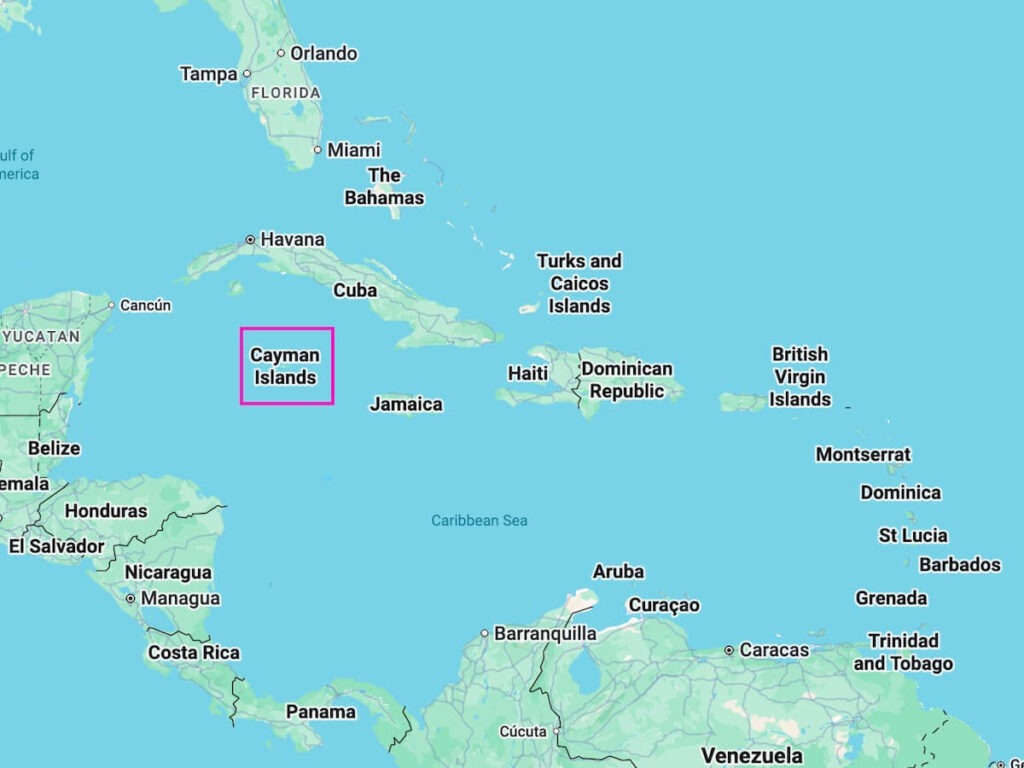

Where is Aruba in Relation to Grand Cayman?
Aruba sits in the southern Caribbean, just 18 miles off the northern coast of Venezuela, about 1,000 miles southeast of Grand Cayman. The two islands are in the same general ocean but at opposite ends of the Caribbean in terms of positioning. Aruba’s location so far south is the reason it sits outside the hurricane belt. Grand Cayman’s more central Caribbean position puts it within storm range.
| Aruba | Grand Cayman | |
|---|---|---|
| Region | Southern Caribbean | Western Caribbean |
| Nearest Mainland | Venezuela (18 miles) | Cuba (150 miles) |
| Coordinates | 12.5° N, 70.0° W | 19.3° N, 81.4° W |
| Distance from Each Other | ~1,000 miles apart | — |
How Far is Grand Cayman from Major US Cities?
Grand Cayman is well within reach of most major US airports, with particularly short flight times from Florida and the Southeast. Owen Roberts International Airport (GCM) handles most international arrivals.
| Departure City | Approximate Flight Time | Direct Flights Available? |
|---|---|---|
| Miami, FL | ~1.5 hours | Yes |
| Atlanta, GA | ~2.5 hours | Yes |
| Charlotte, NC | ~3 hours | Yes |
| New York (JFK/EWR) | ~3.5–4 hours | Yes |
| Boston, MA | ~4 hours | Yes |
| Houston, TX | ~2.5 hours | Yes |
| Chicago, IL | ~3.5 hours | Yes |
| Los Angeles, CA | ~6 hours | Connections via hub |
| Dallas, TX | ~3 hours | Yes |
Flight times are approximate and vary by airline and routing.
How Far is Aruba from Major US Cities?
For comparison, here’s how Aruba’s flight times stack up from the same departure cities. Aruba is served by Queen Beatrix International Airport (AUA).
| Departure City | Approximate Flight Time | Direct Flights Available? |
|---|---|---|
| Miami, FL | ~3 hours | Yes |
| Atlanta, GA | ~4 hours | Yes |
| Charlotte, NC | ~4 hours | Yes |
| New York (JFK/EWR) | ~4.5 hours | Yes |
| Boston, MA | ~5 hours | Yes |
| Houston, TX | ~4.5 hours | Yes |
| Chicago, IL | ~5.5 hours | Yes |
| Los Angeles, CA | ~8 hours | Connections via hub |
| Dallas, TX | ~4.5 hours | Yes |
Grand Cayman has a meaningful flight time advantage for travelers departing from Florida and the Southeast US. From the Northeast and Midwest, flight times are more comparable. From the West Coast, both islands require a connection. More on getting to Aruba.
The Driving Difference
In Grand Cayman, you drive on the left (a British Overseas Territory quirk that catches some American travelers off guard, particularly at the island’s many roundabouts). In Aruba, you drive on the right, using your US license, just like home. Renting a car in Aruba.
Winner
Tie overall, with Grand Cayman having an edge for East Coast/Southeast US travelers on flight time. Aruba has more cities with direct flights.
Beaches: Eagle Beach vs. Seven Mile Beach
This is the headline matchup, and it’s one of the closest calls in the entire comparison.
Aruba: Eagle Beach
Eagle Beach in Aruba is one of the most celebrated beaches in the Caribbean. It’s wide, like exceptionally wide, with enough space that it rarely feels crowded even during peak season. The sand is soft and pale, the water is calm and turquoise, and the iconic divi-divi trees bent by the trade winds line the shore. It’s consistently ranked among the best beaches in the world and is regularly less crowded than its Seven Mile Beach rival. The low-rise resort area behind Eagle Beach keeps development tasteful. More on Eagle Beach.
Grand Cayman: Seven Mile Beach
Seven Mile Beach in Grand Cayman is equally famous and equally deserving of its reputation. It runs for roughly five miles (the “seven” in the name is from historical measurement) along the western coast, lined with resorts, beach bars, water sports operators, and restaurants. The water is calm and brilliantly clear, the sand is white and fine. It’s busier than Eagle Beach as this stretch has more development directly on it, but it’s also more lively if that’s what you’re after.
Beyond the headline beaches, Aruba has more variety. Palm Beach offers a livelier, more resort-focused atmosphere. Baby Beach on the south end is a sheltered lagoon perfect for families. Malmok Beach is a favorite for snorkelers. Grand Cayman’s other beaches (Governor’s Beach, Rum Point, Cemetery Beach) are excellent but fewer and further between.
Winner
Tie. Both are extraordinary. Eagle Beach has more space and feels less commercialized. Seven Mile Beach has more energy and more beachfront amenities. For pure, uncrowded beach perfection, Aruba’s Eagle Beach has a slight edge. For a lively beach-and-bar atmosphere, Seven Mile Beach delivers.
Weather & Hurricane Risk
This is where Aruba earns one of its clearest advantages, not just over Grand Cayman, but over most of the Caribbean.
Aruba
Aruba sits south of the hurricane belt, approximately 18 miles off the coast of Venezuela. It receives less than 20 inches of rain per year (one of the lowest in the Caribbean) and enjoys more than 300 sunny days annually.
The trade winds keep temperatures comfortable (typically 82°F/28°C year-round) without the humidity that plagues many other tropical destinations. You can book Aruba in August and feel confident. You can book in October and not worry. This level of year-round weather reliability is genuinely rare in the Caribbean. Full Aruba weather guide.
Grand Cayman
Grand Cayman has a good climate… warm, generally sunny, with trade winds keeping things comfortable, but it sits within the Caribbean hurricane belt.
Hurricane season officially runs June 1 through November 30. Grand Cayman’s western location provides some natural shielding from Atlantic storms, and it hasn’t taken a major direct hurricane hit since Ivan in 2004. Most hurricane season visits pass without incident, and the island has strong building codes and emergency preparedness systems. But the risk is real in a way that it simply isn’t for Aruba.
| Aruba | Grand Cayman | |
|---|---|---|
| Annual Rainfall | ~18 inches | ~60 inches |
| Hurricane Risk | Extremely low (outside belt) | Moderate (inside belt) |
| Best Travel Window | Year-round | December through April |
| Summer Travel Risk | Very low | Hurricane season awareness needed |
| Average Temp | 82°F / 28°C | 80–88°F / 27–31°C |
| Trade Winds | Consistent, cooling | Present but less consistent |
Winner
Aruba, and it’s not close. If weather certainty matters to you, especially for summer or fall travel, Aruba is the significantly safer booking.
Safety
Both Aruba and Grand Cayman are among the safest destinations in the Caribbean, and this comparison is genuinely close to a tie at the top of the category.
Aruba
Aruba maintains an excellent safety record. Violent crime against tourists is rare, petty theft is uncommon, and the island is a consistent destination for solo travelers, families with young children, and first-time international visitors. The US State Department issues a Level 1 advisory (Exercise Normal Precautions) for Aruba, the lowest possible level. Aruba ranks among the top Caribbean islands on combined safety metrics, including low crime rates and strong tourist infrastructure. Safety in Aruba.
Grand Cayman
Grand Cayman is also very safe. The US State Department likewise issues a Level 1 advisory for the Cayman Islands. Crime rates are low by Caribbean and global standards. The most common issues for tourists involve petty theft (items left unattended on the beach or in rental cars) rather than violent crime. Grand Cayman’s relative wealth (it’s one of the world’s most significant financial centers) contributes to a stable, well-governed environment that prioritizes visitor safety.
Winner
Tie. Both islands are genuinely safe and carry Level 1 US travel advisories. You can visit either with confidence.
Cost: How Much Does Each Island Cost?
Cost is one of the clearest differentiators between these two islands, and Aruba wins on value.
Grand Cayman
Grand Cayman is one of the most expensive destinations in the Caribbean… full stop. Its status as a global financial hub, combined with limited land and heavy reliance on imported goods, drives prices upward across the board.
Mid-range hotels on Seven Mile Beach commonly run $450 to $900+ per night. Fine dining restaurants charge $50 to $150+ per person without drinks. Rental cars are expensive compared to Aruba. Even casual meals can run high.
Aruba
Aruba is not cheap either. It’s solidly mid-to-upper range in Caribbean pricing, but it’s meaningfully more affordable than Grand Cayman across nearly every category. Mid-range hotels typically run $300 to $500 per night during peak season.
There are budget-friendly guesthouses, hostels, and smaller hotels that simply don’t exist in Grand Cayman’s market. Dining ranges from affordable local spots to fine dining, with more options at the lower end. Cost of visiting Aruba.
| Expense | Aruba (Estimate) | Grand Cayman (Estimate) |
|---|---|---|
| Budget hotel/night | $150–$250 | $300–$460 |
| Mid-range hotel/night | $300–$500 | $450–$900 |
| Luxury hotel/night | $500–$1,000+ | $750–$1,400+ |
| Casual restaurant meal (per person) | $15–$35 | $25–$60 |
| Fine dining (per person, without drinks) | $40–$100 | $75–$150+ |
| Rental car/day | $45–$80 | $75–$120 |
| Stingray/snorkel tour | $50–$90 | $60–$100 |
Estimates based on 2024-2025 data. Peak season prices vary significantly.
Winner
Aruba. You get a comparable quality of vacation experience at a lower overall price point.
Diving & Snorkeling
Both islands are excellent for underwater exploration, but they serve different types of divers.
Grand Cayman
Grand Cayman has one of the strongest diving reputations in the entire Caribbean. The island is surrounded by dramatic underwater walls with vertical drop-offs that plunge hundreds of feet into the ocean and hosts some of the Caribbean’s most celebrated dive sites.
The Bloody Bay Wall (technically off Little Cayman, a day trip away) is world-class. The USS Kittiwake shipwreck, intentionally sunk in 2011 off Seven Mile Beach, is accessible to both snorkelers (at the surface) and divers. The visibility is exceptional (often 100 feet or more) and the coral health is strong. Grand Cayman’s location in the western Caribbean means calmer, clearer conditions more consistently throughout the year. For serious, experienced divers, Grand Cayman belongs on the bucket list.
Aruba
Aruba has more to offer than many travelers realize. The Antilla shipwreck, a 400-foot German freighter sunk during World War II, is one of the largest wrecks in the Caribbean and a genuinely impressive dive site. Aruba’s reefs host healthy coral and abundant marine life, and shore diving is accessible in several spots around the island.
Snorkeling is excellent (particularly at Mangel Halto and Tres Trapi) with good visibility and calm conditions. And of course, Stingray City has nothing on Aruba’s own stingray encounter at Aruba’s own sandbar. Aruba also offers diving certifications and wreck diving specialties for those looking to develop their skills.
What about Stingray City?
Grand Cayman’s Stingray City, a shallow sandbar in the North Sound where Atlantic stingrays gather, is one of the Caribbean’s most iconic wildlife encounters. Dozens of southern stingrays have become accustomed to human interaction and can be touched, fed, and photographed in just waist-deep water. It’s genuinely extraordinary and has no direct equivalent in Aruba.
Winner
Grand Cayman for serious divers and snorkelers. Aruba for wreck diving specifically and for casual snorkelers who don’t need the highest-end reef experience.
Activities Beyond the Beach
Both islands offer more than just sand and sea, but Aruba has a meaningful edge in overall activity variety.
Aruba Activities
- Off-road and Jeep tours through Arikok National Park, visiting the Conchi Natural Pool, Casibari rock formations, and remote beaches only accessible by 4×4
- Flamingo encounters at Renaissance Island (exclusive to guests of the Renaissance Hotel, with day passes available) are one of the Caribbean’s most unique wildlife experiences
- Sunset cruises, snorkeling tours, submarine tours, and parasailing
- Casinos: Aruba has a lively casino scene with multiple full-service options including at the Hilton, Ritz-Carlton, and Divi resorts. Casino guide.
- Nightlife centered around Palm Beach and Oranjestad, with bars, clubs, and live music
- Windsurfing and kitesurfing: Aruba’s consistent trade winds make it one of the world’s top destinations for both sports
- Animal encounters including the Donkey Sanctuary, Ostrich Farm, and Butterfly Farm
- Shopping in Oranjestad, including duty-free options
Grand Cayman Activities
- Stingray City: The island’s signature experience and genuinely one of the Caribbean’s best wildlife encounters
- Camana Bay: A planned waterfront town with shops, restaurants, a cinema, and a farmers market; a pleasant walkable area that has no real equivalent in Aruba
- Cayman Turtle Centre: A sea turtle conservation and research facility where visitors can interact with turtles
- Crystal Caves: Dramatic limestone cavern formations (not the same scale as Barbados’s Harrison’s Cave, but interesting)
- Rum Point: A relaxed beach bar area on the quiet north side of the island, popular for a laid-back day trip
- Golf: Grand Cayman has a well-regarded golf course at the North Sound Golf Club
- East End exploration: The less-developed eastern side of the island has a different, quieter feel and some excellent diving and snorkeling spots
Winner
Aruba on variety. Grand Cayman’s activities are excellent but more water-centric. Aruba offers more to do beyond the beach and water, including casinos, off-road adventures, national park exploration, and a wider range of animal encounters. Travelers who want variety in their days will find Aruba the more fulfilling choice.
Food & Dining
This is where Grand Cayman earns its clearest win in this comparison.
Grand Cayman
Grand Cayman has developed one of the most impressive restaurant scenes in the Caribbean (arguably the best). Seven Mile Beach alone has dozens of restaurants ranging from casual beach bars to award-winning fine dining.
The crown jewel is Blue by Eric Ripert inside The Ritz-Carlton Grand Cayman, the Caribbean’s only AAA Five Diamond restaurant, helmed by the chef behind New York’s legendary Le Bernardin. Beyond Blue, you’ll find:
- Luca: Acclaimed modern Italian with a wine list of over 1,200 labels
- The Wharf: Waterfront dining with nightly tarpon feeding
- Ragazzi: Beloved Italian, a local institution for decades
- Cimboco: Caribbean cuisine in a lively, colorful setting
- Anchor & Den: Popular resort restaurant with themed nights and a strong Sunday brunch
The dining culture in Grand Cayman has been shaped in part by its expat financial community… well-traveled people with sophisticated palates and the spending power to support serious kitchens.
Aruba
Aruba has a genuinely good and improving restaurant scene, but it plays in a different league than Grand Cayman for fine dining. The island’s international mix: Dutch, Latin American, American, Indonesian, shows up on menus across Oranjestad and the hotel strip.
You’ll find excellent Italian, fresh seafood, solid steakhouses, and good local spots serving Aruban staples like keshi yena (stuffed cheese), seafood stew, and pan bati (Aruban corn pancakes). The budget restaurant scene is more developed than Grand Cayman’s. There are genuinely good meals to be found at lower price points. Where to eat in Aruba.
For food-focused travelers who consider dining a core part of the vacation experience, Grand Cayman is in a category of its own in the Caribbean. For travelers who want good food alongside everything else, Aruba delivers solid variety without the Grand Cayman price tag.
Winner
Grand Cayman, and it’s a meaningful category for many travelers. Aruba holds its own for variety and local flavor, but Grand Cayman’s fine dining scene is exceptional.
Nightlife
Neither island is a party destination in the way that Nassau, St. Maarten, or Cancún might be, but both have enough evening energy to satisfy most travelers.
Aruba
Aruba’s nightlife is more developed and more varied. The Palm Beach strip has beach bars, clubs, and live music venues. Oranjestad comes alive in the evenings with restaurant traffic and the occasional street festival. Multiple casinos operate late into the night at major resorts. The Jolly Pirates sunset cruise doubles as a floating party. The Chogogo Party Bus tours the island’s nightlife spots. Aruba’s nightlife is fun and varied without being overwhelming.
Grand Cayman
Grand Cayman’s nightlife is more low-key. There are good bars along Seven Mile Beach, the Camana Bay waterfront has a pleasant evening atmosphere, and you’ll find beach bars and live music on most nights. What Grand Cayman lacks is the casino scene (there are no casinos on Grand Cayman), which is a significant difference for travelers who enjoy a late-night session at the tables. The overall after-dark energy is calmer and more refined than Aruba.
Winner
Aruba, particularly for casino fans and travelers who want more after-dark variety.
Where to Stay
Both islands offer accommodation across a range of price points, but the landscape is different.
Aruba
Aruba’s hotel scene is centered around two main areas: the high-rise zone along Palm Beach (larger resort hotels, more amenities, walkable to restaurants) and the low-rise zone along Eagle Beach (smaller properties, quieter, closer to nature).
Top luxury properties include the Ritz-Carlton Aruba, Bucuti & Tara Beach Resort (an adults-only, eco-certified gem consistently ranked among the best hotels in the Caribbean), and the Amsterdam Manor. There’s also a solid selection of all-inclusive resorts, including Manchebo Beach Resort, Divi & Tamarijn, Riu Palace, that don’t exist in Grand Cayman’s market. Budget travelers have options too, including guesthouses and hostels. All accommodation options.
Grand Cayman
Grand Cayman’s hotel scene is more heavily skewed toward the upscale and luxury end. The major properties along Seven Mile Beach include the Ritz-Carlton Grand Cayman (home to Blue by Eric Ripert), the Kimpton Seafire (frequently cited as one of the best hotels in the Caribbean), the Westin Grand Cayman, and the Grand Cayman Marriott.
Many visitors opt for condos or private villas (particularly long-stay visitors) rather than traditional hotels. There are fewer budget options. Prices reflect the island’s overall cost of living, and it’s genuinely difficult to find well-located, quality accommodation under $300 per night.
Notable properties worth mentioning
- Ritz-Carlton Aruba: Full-service luxury on Palm Beach, casino, spa, multiple restaurants
- Bucuti & Tara Beach Resort (Aruba): Adults-only, beachfront, eco-certified, consistently one of TripAdvisor’s top-rated hotels in the Caribbean
- Kimpton Seafire (Grand Cayman): Boutique-luxury on Seven Mile Beach, widely regarded as the finest hotel on the island, with exceptional service and design
- Ritz-Carlton Grand Cayman: Home to Blue by Eric Ripert, top-tier service, prime Seven Mile Beach location
Winner
Aruba for variety and value. Grand Cayman for those who want nothing but the ultra-luxury experience and aren’t price-sensitive.
Families & Kids
Both islands are family-friendly, with a few differences worth noting.
Aruba
Aruba has a wider range of activities specifically suited to families with kids of different ages: Water parks, animal encounters, the Butterfly Farm, the Donkey Sanctuary, atv tours, and the calm water conditions at beaches like Baby Beach that are perfect for young swimmers. The flamingo encounter at Renaissance Island is a particular favorite with kids. Things to do in Aruba with kids.
Grand Cayman
Grand Cayman is also family-friendly. Stingray City is a hit with kids of all ages. The Cayman Turtle Centre combines education with hands-on interaction. Seven Mile Beach’s calm water is safe for young swimmers. Camana Bay’s waterfront has family-friendly restaurants and a pleasant evening atmosphere.
Winner
Aruba for overall family activity variety. Grand Cayman for families where Stingray City is the primary draw.
Aruba vs. Grand Cayman: Which Is Better?
Here’s the direct answer, broken down by who should go where.
Choose Aruba If…
- Weather reliability is a priority, especially if you’re traveling outside December through April.
- You want more activity variety beyond the beach and water.
- Budget matters. You want a comparable quality experience at lower cost.
- You want casino options as part of your vacation.
- You’re traveling with kids and want a wider range of family activities.
- You want the widest possible range of accommodation options.
- It’s your first Caribbean trip and you want a low-risk, high-reward destination.
- You love windsurfing, kitesurfing, or off-road adventure.
- Unique wildlife experiences (flamingos, donkeys, wildlife tours) are appealing.
Choose Grand Cayman If
- Serious scuba diving is the main purpose of the trip, especially wall diving.
- The Stingray City experience is a must-do for you or your group.
- Fine dining is a central part of how you vacation. Grand Cayman’s restaurant scene is exceptional.
- You prefer an ultra-luxury, refined resort experience and budget isn’t a concern.
- You’re flying from Florida or the Southeast US and prefer a shorter flight.
- A quieter, more refined, less commercial atmosphere appeals to you.
- Snorkeling is your main underwater activity and you want the clearest, best-preserved conditions.
Frequently Asked Questions
Grand Cayman is noticeably more expensive across nearly every category: Hotels, restaurants, rental cars, and activities. Aruba is a mid-range Caribbean destination; Grand Cayman is one of the priciest. Budget-conscious travelers will find Aruba the more accessible choice.
Both have world-class beaches. Eagle Beach (Aruba) and Seven Mile Beach (Grand Cayman) are regularly ranked among the best in the Caribbean. Eagle Beach tends to be wider and less crowded. Seven Mile Beach is more developed and lively. The honest answer is that beach quality is essentially equal at the top, but your preference for crowds and atmosphere will determine which you prefer.
Both islands are among the safest in the Caribbean. The US State Department issues Level 1 travel advisories (Exercise Normal Precautions) for both. You can visit either without meaningful safety concerns.
Grand Cayman is the stronger diving destination overall, with world-class wall diving, exceptional visibility, and the famous USS Kittiwake wreck. Aruba’s Antilla wreck is one of the best in the Caribbean for wreck diving specifically, and overall diving conditions are good, but Grand Cayman is in a higher tier for serious divers.
No. Grand Cayman has no casinos. Aruba has multiple full-service casinos at major resort properties. This is a meaningful difference for travelers who enjoy gaming.
Not easily. The islands are far apart (over 1,000 miles), and connecting flights would require routing through the US or another hub. Most travelers choose one per trip. The exceptions would be those doing an extended multi-island Caribbean trip with flexibility in routing.
Aruba can be visited year-round with confidence. There’s no bad time, though the peak season (December through April) sees the highest prices and most visitors. Grand Cayman is best visited December through April to avoid the rainy season and hurricane risk; traveling June through November introduces real storm risk.
Both are popular honeymoon destinations, but they serve different preferences. Grand Cayman offers a more refined, intimate experience (quieter, more private, exceptional dining). Aruba offers more variety, more activity, and more consistency in weather.
Bucuti & Tara Beach Resort in Aruba is one of the Caribbean’s most consistently praised adults-only properties. Ultimately, honeymooners who love adventure and variety will lean Aruba. Those who want a pure, luxurious, beach-and-dining retreat may lean Grand Cayman.
Ready to Plan Your Aruba Trip?
If Aruba has won you over, we’ve got everything you need to plan your trip from start to finish:
- Where to Stay in Aruba: From budget-friendly picks to five-star beachfront resorts
- All-Inclusive Resorts in Aruba: Everything included, nothing to worry about
- What to Do in Aruba: The best tours, beaches, and activities on the island
- Where to Eat in Aruba: From local gems to special-occasion dinners
- Safety in Aruba: What you need to know before you go
- Weather in Aruba: When to visit and what to expect
- Cost of Visiting Aruba: How to budget your trip
Still Comparing?
See how Aruba stacks up against all the other top Caribbean islands in our complete Aruba vs. Caribbean Islands comparison guide.


